
Biopharmaceuticals and other highly sensitive sterile products are typically manufactured in critical Grade A environments involving gloved or gloveless isolators or aseptic fill-and-finish lines, for which stringent regulation is in place to ensure product integrity. This carries the risk of microbial contamination with potentially grave consequences: Any delay in detection can cost much extra time needed for investigations and corrective action, require valuable batches to be discarded or even cause health risks in patients.
This is why the revised EU GMP Annex 1 and other recent regulations have been suggesting the use of continuous monitoring to detect transient contamination events that traditional monitoring may miss. Such methods are now considered best practices rather than mere options. Facilities are increasingly seeing the need to adapt their environmental monitoring strategies accordingly. Continuous microbial air monitoring can generate powerful data in realtime to:
- Make aware of any deviations immediately
- Enable faster reactions to contamination events
- Lower the overall risk of products becoming compromise
In addition to these benefits at operational level, there are strategic advantages of implementing continuous monitoring. The comprehensive real-time data this generates helps to:
- Improve contamination control strategies
- Enhance the understanding of cleanroom dynamics
- Position companies at the forefront of compliance, efficiency and innovation
Which realtime technologies are available?
At present, Biofluorescent Particle Counters (BFPCs) represent the pharmaceutical industry's only practical option for continuous real-time microbial air monitoring. These instruments are based on laser-induced fluorescence (LIF) to detect particles that exhibit fluorescence signatures associated with biological material. When airborne particles pass through the detection chamber, they are exposed to light of specific excitation wavelengths. The fluorescence that the particles emit is simultaneously analyzed to distinguish between total airborne particles and autofluorescent particles.
While basic instruments may struggle to distinguish between viable particles (containing living microorganisms) and non-viable fluorescent particles (e.g. residues from disinfectants, other autofluorescent organic or inorganic materials), the most advanced systems such as the Rapid-C+ Biofluorescent Particle Counter go a lot further, basing their results on:
- Excitation wavelengths that include those of key viability markers such as NAD(P)H or flavins
- Sophisticated analysis of fluorescence emission patterns
- Morphological assessment of particles
This combination of criteria improves the reliability of viable particle identification tremendously.
Performing continuous real-time and conventional air monitoring simultaneously
Conventional air sampling will remain necessary, in particular because it is necessary to identify and characterize detected microbial contaminants according to GMP requirements. Simultaneously performing conventional sampling and continuous real-time monitoring improves overall data quality because the two methods generate results in complementary meaningful metrics that usually correlate:
- Colony forming units (CFUs) as a measure of cultivable organisms and
- Viable particles, which include non-cultivable organisms (Figure 1)
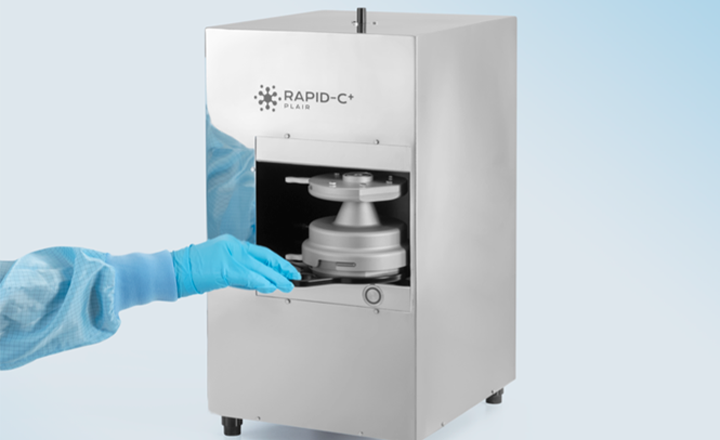
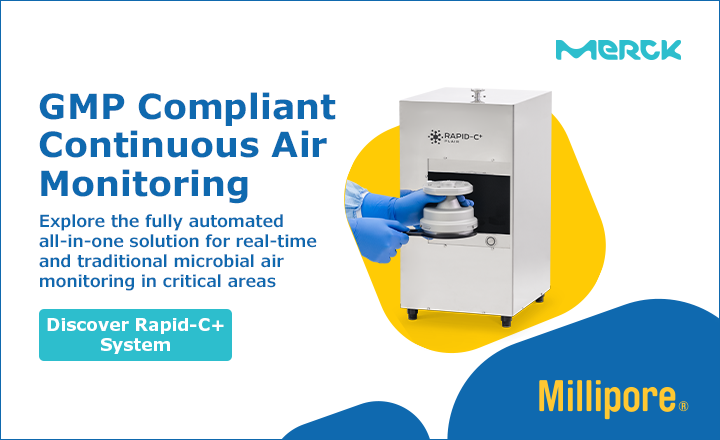
Customer validation also becomes significantly easier if CFUs are determined alongside running the alternative viable particle detection method—and even more so if the instrument’s manufacturer can provide robust validation data. For these reasons the Rapid-C+ Biofluorescent Particle Counter integrates an impaction-based active air sampler that is independently validated for both physical and biological collection efficiency. It thus allows conventional microbiological air monitoring to be performed alongside continuous rapid monitoring in a single instrument. Plates only need handling outside the critical sampling points, making the manufacturing process safer and faster while increasing the available time for production on the filling line. Although it is possible to prepare the required plates under a separate laminar flow hood, using ready-to-use media such as ICR/ICRplus Settle Plates further reduces the cross-contamination risks.
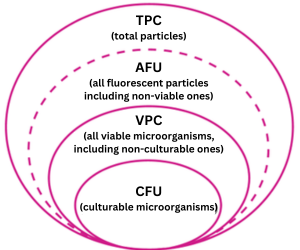
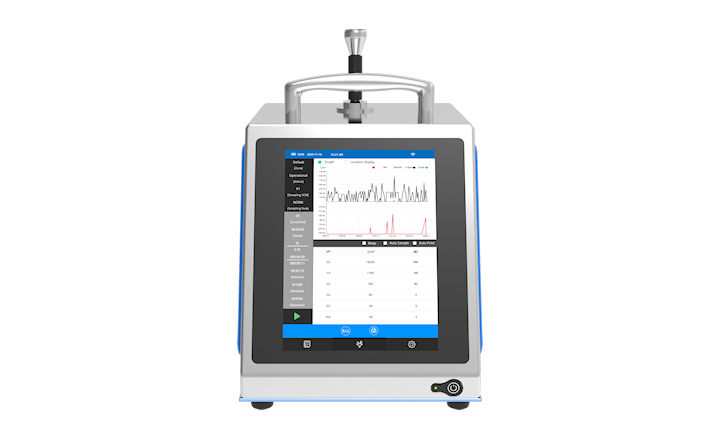
Figure 1: The Rapid-C+ system performs total particle counts (TPC) and viable particle count (VPC) in real time, alongside GMP-compliant active air sampling for enumeration of cultivable microorganisms as CFUs
Key considerations for implementation
Before implementing continuous real-time microbial monitoring, pharmaceutical companies should carefully assess the associated technical and operational considerations
For new manufacturing isolators or aseptic filling lines, continuous real-time monitoring should be considered as early as during the planning stage. This allows the necessary infrastructure and technology to be put in place and made available from the outset.
Existing facilities should include further considerations in their feasibility assessments:
- Retrofitting constraints
- Likely production downtime
- Integration with the data systems currently in use
For any facility, validation and the effort this involves is a further important factor. They should:
- Look closely into manufacturer-provided validation data
- Estimate the effort required for site-specific performance qualification (PQ) to confirm system performance under actual production conditions
- Ensure the monitoring system complies with GMP guidelines, applicable ISO standards and pharmacopeial guidance
The bottom line
Continuous real-time microbial air monitoring can provide substantial benefits to pharmaceutical manufacturing facilities, particularly those operating in isolators and automated aseptic processing environments. By detecting microbial contamination in real-time, and thereby enabling immediate corrective action, BFPCs can save valuable time, effort and costs. Continuously monitoring the air for contaminants helps to detect deviations earlier and improve the understanding of cleanroom dynamics. Simultaneous conventional air sampling,as performed alongside real-time monitoring by the Rapid-C+ system, provides comprehensive complementary data for analysis while making it easier to meet regulatory requirements.
Learn more about Rapid-C+ System