
An interview with Dr Frederic Berkermann, Commercial Project Lead EMEA for Merck’s automation and robotics solutions, on the financial and strategic considerations of automating microbial quality control (QC) in pharmaceutical manufacturing.
Q: Automation and robotics in microbial QC are hot topics. What is driving the transition?
Frederic: QC labs are facing an array of rising demands. Manufacturing processes, particularly in biopharmaceuticals, are becoming more complex, while regulatory expectations continue to increase. The more manual tasks there are, the likelier handling or documentation errors will occur, bringing with them the loss of valuable time and resources spent on corrective action, and possibly precious product batches going to waste. Any delay can throw manufacturing and product supply schedules into disarray. Many facilities are also contending with a limited availability of skilled personnel, with a substantial share of staff time being spent on repetitive manual tasks such as plate preparation, sample transfers, incubation management and documentation. And then there are the continuing price pressures due to ever increasing worldwide competition in the pharmaceuticals market.
Q: How can automation help to solve these challenges?
Frederic: Automated systems operate with consistent precision and repeatability, which reduces the risks of human error and of cross-contamination. This leads to more robust test results and fewer false positives, improving both reliability and efficiency. Another key benefit is productivity. Because automated systems generate comprehensive data in realtime and are available around the clock, investigations can be completed faster and at lower cost, reducing the likelihood of batch losses. The COVID-19 vaccine rollout highlighted how critical it is not only to get results right the first time but also to scale up capacity quickly. Automation will play a central role in enabling that flexibility.
Automation and robotics come with digitalization as both an enabler and an amplifier of efficiency gains. Automated data capture across the entire workflow—from material selection to final reporting—ensures full data integrity and traceability, two key aspects of regulatory compliance. At the same time, the comprehensive data that is captured can be analyzed to detect trends and deviations early, accelerating investigations into out-of-specification results. Even on its own, digitalization improves efficiency by optimizing scheduling and reducing manual documentation. When combined with automation the impact is even greater, as it reduces human intervention, lowers contamination risks, and helps prevent production stoppages.
Q: How is Merck developing its automation and robotics solutions?
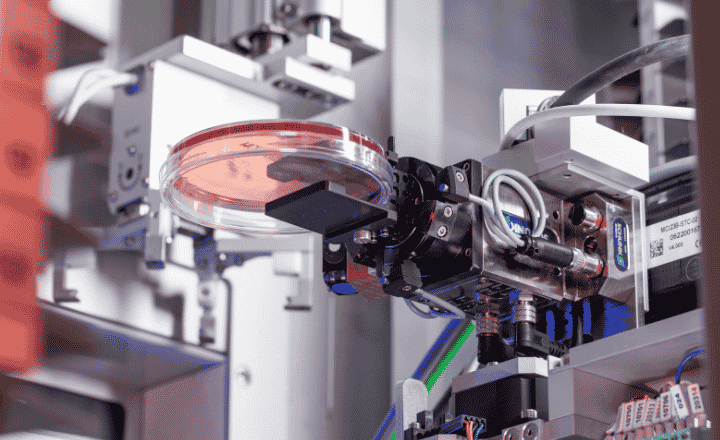
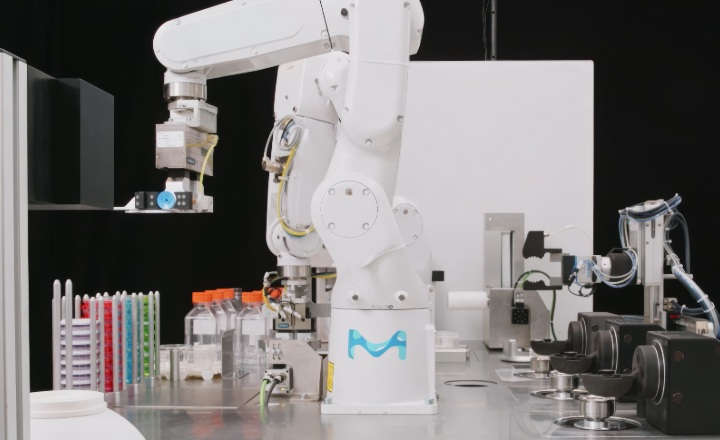
Frederic: In cooperation with leading pharmaceutical customers and engineering partners, we have already developed fully functional solutions, a mobile robot for environmental monitoring and a stationary machine for automated bioburden testing. As a worldwide leader in pharmaceutical QC, we are in the fortunate position to be able to draw upon the microbiology QC expertise we have gained over the decades. This has helped us to drive the transition that is now happening in the industry. In our cooperations, we have been working closely with customers in the development process. Rather than tell them what we think they need, we listen as they tell us what they expect. Our aim is to standardize our solutions to make it feasible to offer them to a wider market. Standardization would also facilitate validation and life-cycle management.
It’s worth pointing out that not all microbial QC tasks will be fully automated. In sterility testing, for example, customers use very different protocols and consumables, so standardization is not the way to go here. On the other hand, it is critical that technicians follow their typically quite complex SOPs precisely. This is why we have based our M-Trace® solution for sterility testing, which is already available, on automated software guidance with simultaneous realtime data capture. This significantly lowers the risk of handling errors while ensuring traceability. The software uses either speech or screen-displayed prompts to guide the operator through a customized and digitalized testing SOP, giving step-by-step instructions and recording user feedback automatically.
Q: The necessary capital expenditure (capex) for automation and robotics is, however, considerable. How do you best address this issue?
Frederic: While the benefits of automation are widely recognized, the real challenge often lies in securing investment. Microbiology automation competes with other projects for both funding and attention, which is why QC managers need to clearly articulate its value. This means presenting a structured case that links costs to tangible value drivers and aligns with the financial and operational criteria used by the manufacturing and finance stakeholders.
In practice, return on investment (ROI) discussions in lab automation often start with an all-too-narrow focus on direct labor savings. This is because it is intuitive to assume that automation of tasks like plate handling, air sampling, or incubation reduces the need for manual work and therefore headcount. However, in QC microbiology, reducing staff levels is rarely the primary goal—or even realistic. Given the constantly increasing QC testing volumes, the real objective is to use the existing expertise more effectively.
A more meaningful approach is to frame ROI in terms of the total cost of quality. From this perspective, automation impacts prevention costs by supporting the design and execution of contamination control strategies; the appraisal costs of routine testing; and the costs of failure by reducing deviations, rework, waste, and interventions by regulatory bodies. Automation can deliver value across all of these areas, at various levels, not just through labor efficiency.
Q: Many of these benefits are, however, difficult to quantify.
Frederic: That’s true. But ignoring them leaves you with a wholly incomplete calculation. From a business perspective, it’s more meaningful to distinguish between two types of benefits. At operational level the benefits include direct savings and capacity gains, for example due to reduced overtime, the ability to handle higher sample volumes without proportional increases in headcount, and the elimination of manual testing steps. Because these can be translated into tangible metrics, they form the quantitative foundation of most business cases. The second type consists of strategic benefits. These include stronger data integrity and audit readiness, a reduced risk of investigations becoming necessary, the ability to better fulfill likely future regulatory requirements such as electronic records or advanced analytics, and improved attractiveness of the QC lab for staff. While such benefits are harder to quantify, they are highly relevant at corporate level, where longer-term considerations, brand reputation, and improbable but potentially severely damaging events are weighed alongside short-term financial returns. Taking both types of benefits into consideration allows investments in microbial QC automation to be assessed on an equal footing with more traditional manufacturing investment cases.
Q: Will all manufacturing facilities be able to benefit from automation and robotics solutions?
Frederic: I believe it is safe to say that automation and robotics solutions have benefits for more companies than widely assumed. High testing volumes and throughputs can be the main consideration to switch to automation, but so can other factors, for example specific challenges with a manufactured product. If valuable batches frequently have to be discarded because of contamination issues that could be avoided by automation, then transitioning can have a dramatically beneficial financial impact, and it would make a lot of sense to talk with us about potential solutions. The same is true if rapid detection of contamination would make a difference in production planning.
Multinational companies should consider implementing an automation solution at several of their facilities around the world because this would save them the effort and costs of having to fully evaluate, plan and validate very different QC methods everywhere. Particularly when there are plans to build new facilities, it is highly advisable to consider the requirements for automation and robotics from the very onset, for example by making sure that the floor layouts and spatial requirements will be adequate. Although it should be possible to adapt an existing facility at a later time, there would be no operation during conversion, and the total costs would be higher.
It’s also important that manufacturers keep the capability to perform manual testing for when maintenance is performed on the automated system as well as for validation and revalidation purposes, given that they constantly have to deal with new matrices. So it’s not either manual or automated testing - they complement each other.
Learn more about Merck’s QC robotics & automation solutions