
For most QC teams in pharmaceutical manufacturing, environmental monitoring is one of the most labour-intensive parts of the job. Technicians gown up, enter controlled zones, place active samplers and settle plates, operate instruments, and even sometimes manually record results. With updated EU GMP Annex 1 requirements raising the bar on continuous monitoring, data integrity, and contamination control documentation, those manual workflows are under real strain.
The deeper issue is that manual monitoring is not just time-consuming. Every person who enters a cleanroom is a potential contamination source. Inconsistent sample placement, rushed procedures, and transcription errors are routine risks. In critical environments where limits are already tight, the margin for human variability is essentially zero. Automation does not just save time; it removes a whole category of risk from the process.
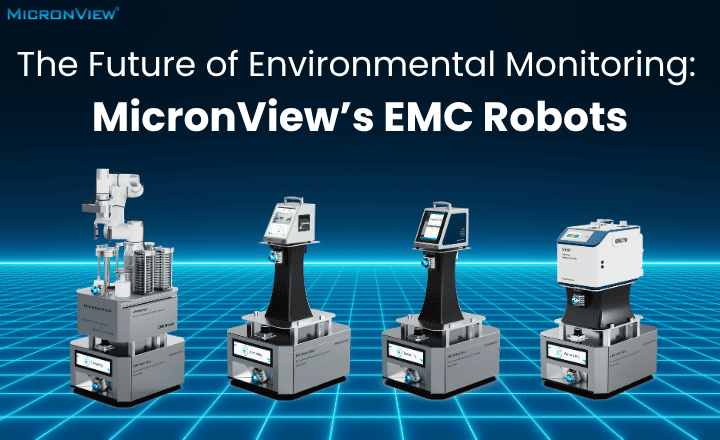
MicronView's EMC robot line was designed with this in mind. All four robots share the same EMC Robot Base platform, with functional modules that are interchangeable across the line. A facility can start with one capability and add others later without rebuilding infrastructure or restarting qualification from scratch. For QC teams navigating phased rollouts and change control, that modularity is a practical advantage.
APC Robot (Non-Viable Particle Counting)
For teams whose immediate priority is non-viable particle counting, the APC Robot handles airborne monitoring autonomously. It follows pre-mapped routes around the clock, docks and recharges automatically between runs, and eliminates the need for technician entry during routine sampling. For high-frequency sampling programs, the reduction in personnel time and cleanroom entries is immediate.
Dual-Mode Robot (Particle Counting and Viable Air Sampling)
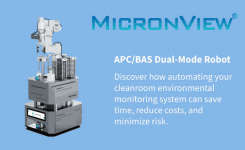
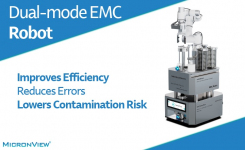
For environments that require frequent viable air sampling alongside particle counting, the Dual-Mode Robot handles both in a single platform. A six-axis robotic arm places and retrieves 90 mm agar plates with sub-millimetre repeatability, while the onboard particle counter runs simultaneously. Two workflows, one autonomous system. It is particularly well-suited to environments where both data types are required under Annex 1 and multiple daily entries would otherwise be necessary.
BAMS Robot (Real-Time Bioaerosol Monitoring)
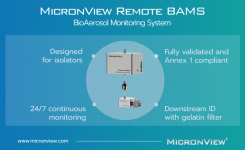
The BAMS Robot takes a fundamentally different approach to viable monitoring. Rather than culture-based sampling, it uses biofluorescent particle counting to detect potential contamination in real time. Where traditional methods take one to seven days to produce results, the BAMS Robot provides data immediately. For critical zones where early detection is the priority, and for facilities working toward continuous viable monitoring under Annex 1, it offers a capability that has not previously been practical to run at scale.
VHP Robot (Automated Decontamination, Coming Late 2026)
Coming late 2026, the VHP Robot automates vaporised hydrogen peroxide decontamination across programmable cleanroom routes, delivering 99.9999% disinfection efficacy. It can coordinate with the monitoring robots to verify that decontamination has been effective before sampling resumes, connecting detection and remediation within the same automated system.
As regulatory expectations continue to evolve, environmental monitoring programs are moving toward greater automation, consistency, and real-time visibility. MicronView’s EMC Robot Line was designed to help facilities reduce intervention, strengthen contamination control strategies, and build the next generation of cleanroom monitoring workflows.
Learn more about the MicronView EMC robot line