

Updated 16 February 2026
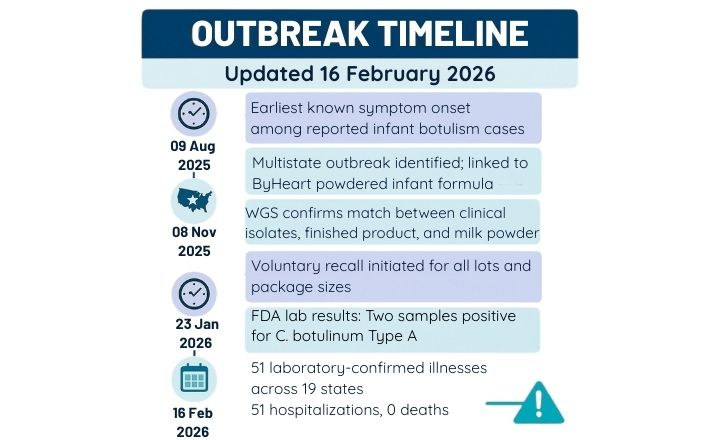
A multistate outbreak of infant botulism (Type A toxin) was identified in 2025 and linked to ByHeart Whole Nutrition powdered infant formula1. WGS analyses showed that the clinical isolates matched to finished product and whole organic milk powder.
Per CDC, all lot numbers and all sizes of cans and single serve packets were recalled.
- Outbreak includes:
- 51 laboratory-confirmed illnesses across 19 states
- 51 hospitalizations, 0 deaths
- Ages range from 16 – 264 days; slight majority of cases are male (57%).
- Cases with onset began as early as August 9, 2025, the outbreak investigation remains open.
- US FDA began coordinating with CDC, state health departments, and the California Department of Public Health (CDPH) to investigate on ~ November 6, 2025
- Voluntary Recall was Initiated November 8, 2025
- As of January 23, 2026, two samples collected by FDA tested positive for Clostridium botulinum (toxin), Type A. One is a ByHeart powdered infant formula closed product sample that genetically matches a clinical isolate from an infant included in this outbreak. These samples also match two isolates from an organic whole milk powder used by ByHeart in the production of ByHeart Whole Nutrition powdered infant formula, which were collected and tested for by ByHeart.2
This is the first confirmed infant botulism outbreak involving contaminated infant formula. Previous to this, there have been 3 case reports, one from China (2017)3 and two cases from the UK (20014, 20055), each involving a single infant that may have been sickened with Clostridium botulinum as a result of consuming contaminated infant formula. Of note, epidemiological analyses could not establish intrinsic product contamination.
References:
- FDA website Outbreak Investigation of Infant Botulism: Infant Formula (November 2025) accessed on 2/2/2026. https://www.fda.gov/food/outbreaks-foodborne-illness/outbreak-investigation-infant-botulism-infant-formula-november-2025
- FDA website Outbreak Investigation of Infant Botulism: Infant Formula (November 2025) accessed on 2/2/2026.
https://www.fda.gov/food/outbreaks-foodborne-illness/outbreak-investigation-infant-botulism-infant-formula-november-2025 - Dong et al. 2017. Molecular and Epidemiological Characterization of Infant Botulism in Beijing, China. Biomedical and Environmental Sciences. https://www.besjournal.com/en/article/doi/10.3967/bes2017.061
- Johnson et al. 2005 Characterization of Clostridium botulinum strains Associated with an Infant Botulism Case in the United Kingdom. Journal of Clinical Microbiology. https://doi.org/10.1128/jcm.43.6.2602-2607.2005
- Brett et al. 2005. A Case of Infant Botulism with a Possible Link to Infant Formula Milk Powder: Evidence for the Presence of More than One Strain of Clostridium botulinum in Clinical Specimens and Food. Journal of Medical Microbiology. https://doi.org/10.1099/jmm.0.46000-0