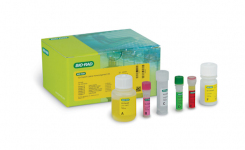


The safety of powdered infant formula is one of the most critical challenges in food manufacturing today. Recent incidents involving cereulide intoxication in infant formula underscore the paramount importance of implementing robust safety protocols throughout the manufacturing process.
Powdered Infant formula presents unique microbiological challenges due to its complex matrix composition and inherently high background flora levels. The contamination risks extend beyond spore-forming Bacillus cereus to encompass critical Enterobacteriaceae pathogens, particularly Salmonella spp. and Cronobacter spp., each requiring specialized detection and control strategies.
Recognizing these industry-wide challenges, Bio-Rad has developed comprehensive, validated solutions specifically engineered for powdered infant formula manufacturers. These solutions address the dual requirements of achieving exceptional selectivity and performance while maintaining operational simplicity for routine implementation.
In this exclusive rapidmicrobiology interview with Gulustan Kuccuk, Global Product Manager for Food Safety at Bio-Rad Laboratories, we explore the technical drivers behind Bio-Rad's product developments and discover how Bio-Rad has successfully balanced analytical precision with practical usability, delivering benefits to both product safety and improved manufacturing efficiency.
Q: Bio-Rad explicitly treats infant formula as a special, high-risk matrix, and not just another food. What makes it a challenging matrix?
Gulustan: Powdered infant formula is challenging for three reasons: who it serves, what it contains, and how low the tolerance is for uncertainty. It is consumed by a highly vulnerable population, so the acceptable risk is extremely low. From an analytical standpoint, powdered infant formula is a complex matrix that often contains ingredients that can complicate microbiology - including probiotics and other lactic bacteria that can create a high background flora, make enrichment less selective, and increase the risk of false negatives if targets are stressed or present at very low levels.
On top of that, routine powdered infant formula workflows frequently involve large test portions (e.g., up to 375 g in some validated approaches), which increases handling complexity and makes consistency and harmonisation of protocols critical. The industry has also seen that some hazards are not solved by “just heat”: for example, cereulide (a toxin produced by some Bacillus cereus group strains) is not inactivated by heating, so prevention and upstream control become essential.
Q:In response to the 2018 Salmonella outbreak in France, Bio Rad chose to focus on delivering a highly optimized, reliable solution rather than rushing to market. This thoughtful approach resulted in the development of the Bio Rad PIF Supplement. What advantages did this strategy deliver? What are the benefits of this supplement?
Gulustan: When it comes to powdered infant formula, the most important criterion is method performance. At the time, Bio-Rad was not satisfied with the sensitivity and robustness of the selective enrichment options available, particularly for matrices with high background flora and stressed target cells. Rather than moving forward with a solution not fully adapted to infant formula constraints, Bio-Rad chose to develop a supplement adapted to the specific challenges of powdered infant formula.
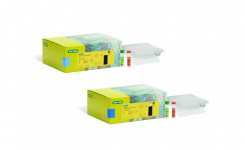
The result was the PIF Supplement, designed for use with buffered peptone water (BPW) for the enrichment of Enterobacteriaceae, especially Salmonella spp. and Cronobacter spp. It was initially positioned for powdered infant formula with or without probiotics, related ingredients, and environmental samples from powdered infant formula production areas but can also be used for enrichment of other low moisture foods, for example flour.
From a laboratory standpoint, this solution delivers four clear benefits. It offers strong selectivity while maintaining high sensitivity, effectively controlling background flora, including probiotics, without compromising recovery of stressed target organisms. It also brings real workflow harmonisation, as a single enrichment step can be used for both PCR screening and RAPID’ chromogenic confirmation, reducing complexity and training effort. In addition, the supplement is well suited for large test portions, supporting sample sizes up to 375 g with a consistent 1:4 dilution ratio, which helps minimise the risk of false negatives in low-level contamination scenarios. Finally, the development deliberately prioritised robustness and reliability over speed, fully supporting a risk-based approach to infant formula microbiology. .
Q: Bio-Rad’s Chromogenic RAPID’B.cereus agar is very impactful with its bright red colonies on a blue background. Aside from being very clear and easy to read, what other advantages does it offer? Can it be used for enumeration of both vegetative cells and spores
Gulustan:RAPID’B.cereus is designed for rapid and reliable enumeration of the Bacillus cereus group, including both vegetative cells and spores, with results available in around 24 hours without the need for confirmation. One of its key strengths is the exceptional ease of reading: the medium provides a very clear and distinctive color contrast between target colonies and the background, making results immediately interpretable. This strong visual differentiation significantly reduces ambiguity, operator subjectivity, and rereads, even on raw or complex matrices.
Beyond readability, the medium offers high selectivity, limiting interfering flora and reducing rework, while maintaining strong sensitivity for all pathogenic B. cereus strains, including difficult to culture species such as B. cytotoxicus. Colony behaviour is also well controlled, preventing rhizoid spreading and ensuring accurate enumeration. Finally, the method provides flexibility for laboratory workflows, with options for surface or pour plate inoculation and the ability to store plates before reading, helping laboratories manage workload peaks efficiently.
Q: What advice do you have for food manufacturers impacted by the recent recall of powdered infant formula?
Gulustan: In this context, the focus is on reassessing certain areas in light of evolving risk knowledge. This includes reviewing supplier and ingredient risk, particularly for widely used, high impact ingredients, and ensuring traceability systems allow rapid and targeted containment when needed.
Manufacturers may also benefit from reinforcing environmental monitoring and hygiene verification, as risks in powdered infant formula can be linked to the production environment as much as to the finished product. In parallel, harmonising and periodically stress testing microbiological workflows can help reduce false negatives and maintain operational resilience during periods of increased scrutiny.
Finally, close alignment with competent authority guidance remains essential. In Europe, the evolution of the regulatory framework, illustrated by Regulation (EU) 2026/459 amending Regulation (EU) 2019/1793, demonstrates how critical regulatory adaptation is in response to emerging scientific evidence. While this evolution may sometimes feel slower than the urgency of crises would warrant, it reflects the need for robust, science based decision making to ensure sustainable and effective protection. This evolution reflects the close and ongoing collaboration between authorities, experts, and industry stakeholders, and supports informed, proportionate decision making to protect vulnerable populations, particularly infants under six months of age.
Q: Can Bio-Rad advise powdered infant formula manufacturers on the development of a risk-based approach to testing incoming raw materials and finished goods?
Gulustan: Bio-Rad can support powdered infant formula manufacturers by providing validated, harmonised analytical solutions and by sharing how these solutions can align with common control points within a risk-based testing strategy. Our role is to support areas where the industry requires high selectivity, the ability to test large sample sizes, and consistent, reproducible workflows across raw materials, the production environment, and finished products.
Within a risk-based testing strategy spanning incoming materials, the production environment, and finished goods, manufacturers typically apply complementary controls. These include harmonised detection of Salmonella and Cronobacter in high-risk matrices, hygiene monitoring using Enterobacteriaceae as an indicator family, and selective chromogenic enumeration of the Bacillus cereus group for reliable counting of vegetative cells and spores.
Sustainable powdered infant formula testing also relies on efficient laboratory organisation. Harmonised methods and simplified protocols help optimise resources, training, and workload management, with Bio-Rad supporting method alignment and validation while overall HACCP responsibility remains with the manufacturer.
Q: You recently received MicroVal validation for your iQ-Check Enterobacteriaceae Kit for infant formula. Can you tell me about the role of these real-time PCR kits in fast, qualitative detection of major pathogens?
Gulustan: Real-time PCR plays an important role in powdered infant formula testing by enabling fast, qualitative screening that can be efficiently integrated into routine laboratory workflows, particularly when combined with validated enrichment and confirmation strategies. The iQ-Check real-time PCR kits provide a reliable and faster alternative to classical methods for the qualitative detection of major food pathogens in food and environmental samples.
For iQ-Check Enterobacteriaceae specifically, the method has received MicroVal certification as equivalent to ISO 215281:2017, with a scope that explicitly includes infant formula and infant cereals with or without probiotics, as well as related ingredients up to 375 g, under certificate 2018LR80.
The MicroVal validated workflow includes enrichment using prewarmed BPW with the addition of PIF Supplement, the use of the Free DNA Removal Solution (FDRS) to reduce signals from free or dead cell DNA, rapid lysis, and PCR analysis on validated Bio-Rad CFX thermal cycler platforms. Confirmation can be performed either using RAPID'Enterobacteriaceae or the ISO reference method.
A key strength of the Bio-Rad approach is the harmonisation of the ISO 16140-2–certified workflows for the detection of Salmonella spp., Cronobacter spp. and Enterobacteriaceae. This allows laboratories to apply a single enrichment and a consistent PCR strategy across multiple critical hazards in powdered infant formula testing.
Q: Can you outline a case study/success story in which you helped a manufacturer of powdered infant formula to develop a risk-based food safety plan utilising the products in Bio-Rad’s Food Safety Toolkit?
Gulustan: One example is our collaboration with a global powdered infant formula manufacturer producing both standard and probiotic containing products, aiming to strengthen its risk-based food safety strategy in a context of increased regulatory and consumer scrutiny.
The key challenge was to minimise the risk of false negatives while maintaining a practical, cost-effective testing approach across raw materials, in process controls, and finished products, including large composite samples, and to deploy it consistently across multiple sites.
The strategy was built around three pillars. First, a harmonised enrichment approach using BPW with PIF Supplement, enabling reliable detection of Salmonella, Cronobacter, and Enterobacteriaceae, including in probiotic matrices, while simplifying training and audits. Second, rapid PCR screening with iQ-Check kits combined with selective confirmation using RAPID’ chromogenic media to shorten time to decision. Finally, targeted enumeration of the Bacillus cereus group using RAPID’B.cereus agar to support trend analysis and preventive controls.
A key strength of the Bio-Rad approach is the harmonisation of the ISO 16140-2–certified workflows for the detection of Salmonella spp., Cronobacter spp. and Enterobacteriaceae. This allows the laboratories to apply a single enrichment and a consistent PCR strategy across multiple critical hazards in powdered infant formula testing.
Q: What’s next? Are Bio-Rad working on solutions to advance pathogen detection in powdered infant formula?
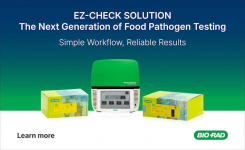
Gulustan: Yes, absolutely. Bio-Rad’s roadmap reflects the need for earlier, faster, and more robust detection in powdered infant formula, and the EZ-Check solution clearly illustrates this direction.
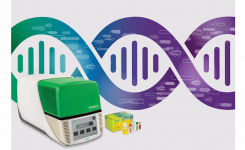
EZ-Check advances qualitative pathogen detection by simplifying and standardizing real-time PCR workflows while maintaining the robustness required in highly regulated, sensitive environments. By combining an ultra-simple protocol with robust, validated PCR assays, it helps reduce hands-on time, operator dependency, and variability - key factors when scaling testing across sites. The solution is compatible with the iQ‑Check Prep System, enabling automation that enhances traceability, robustness, and scalability, while reducing operator dependency and improving reproducibility.
More broadly, Bio-Rad is reinforcing a system-level approach to powdered infant formula testing, aligning selective enrichment, rapid molecular detection with EZ-Check, and chromogenic confirmation. This makes advanced testing easier to standardize, justify to auditors, and deploy consistently across global operations.
Recent events have highlighted the importance of upstream detection, particularly for risks. In this context, Bio-Rad continues to focus on highly selective enrichment and validated, harmonized workflows designed for high-risk matrices like powdered infant formula.
Discover Bio-Rad's Food Safety Testing Solutions
About Gulustan Kuccuk - Global Product Manager for Food Safety at Bio-Rad