



Recent media reports have revealed that contaminated infant formulas were identified on the market in several European countries, highlighting a critical food safety issue. These products are intended for highly vulnerable consumers. Bacillus cereus remains a key organism of concern due to its heat-resistant toxin, ability to survive in powdered milk, and its potential to cause serious illness in infants.
Bacillus cereus is a spore-forming bacterium that can be frequently isolated from soil and some food, and which produces toxins. These toxins can cause two types of illness: one type characterized by diarrhea (long incubation, 8-16 hours) and the other by nausea and vomiting (short incubation, 1-6 hours).
The short-incubation form is most often associated with rice dishes that have been cooked and then held at warm temperatures for several hours. Long-incubation B. cereus food poisoning is frequently associated with meat or vegetable-containing foods, after cooking. The bacterium has been isolated from dried beans and cereals, and from dried foods such as spices, seasoning mixes, and potatoes.
The short incubation or emetic form of the disease is diagnosed by isolation of B. cereus from the incriminated food. The long-incubation or diarrheal form is diagnosed by isolation of the organism from food.
Key Points:
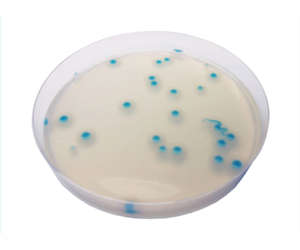
- Easy reading after only 18-24 h at 30 °C - The intensely blue-colored colonies on a translucent agar facilitate reading compared to Mannitol-based agar, which displays red colonies on pink agar.
- Simplicity - Contrary to MYP or Mossel agar, there is no need to add the Egg yolk emulsion.
- Highly sensitive & specific for the cereus group - The classical MYP or Mossel agar relies on the inability of B. cereus to use the mannitol, which renders plate reading difficult in the presence of abundant flora. CHROMagar™ B. cereus, due to its chromogenic technology, overcomes this difficulty.
- Better selectivity & recovery compared to classical media - 100 % Sensitivity / 100 % Specificity (Adria Normandie Study, 2012)
- Longer prepared plate shelf life compared to MYP and Mossel agar, which only have a 5-day shelf life.