

At MEDICA 2025 in Düsseldorf, one of the world’s leading trade fairs for medical technology and diagnostics, ProGnosis Biotech unveiled a new generation of Hygiene Monitoring Solutions that push cleanliness verification beyond what the eye can see. Building on real-time ATP testing for surfaces and CIP/rinse water, the company now combines ultra-sensitive ATP detection with targeted protein residue testing to deliver fast, objective evidence of cleaning performance.
As infection-prevention programs and food safety systems become more risk-based, studies increasingly show that visual inspection alone is too subjective to guarantee hygienic surfaces, recommending additional objective methods such as ATP or residue tests at critical points 1,2.
Why Combine ATP and Protein Residue Testing?
ATP testing is widely used as a rapid, non-microbiological indicator of cleaning effectiveness. Residual ATP on a surface suggests the presence of organic material and potential microbial contamination. Studies in both food manufacturing and healthcare environments have shown its value for targeting inadequate cleaning 3,4.
However, ATP alone cannot distinguish between different soil types (e.g. food residues, body fluids, environmental organic load). Protein residue tests add another layer of control, directly detecting residual proteins that may shield microorganisms or signal incomplete removal of organic material. Using ATP and protein residue detection together therefore supports:
- More comprehensive verification of cleaning steps
- Better risk assessment at critical control points
- Stronger documentation for audits and quality systems
ATP-Flow Surface & ATP-Flow Total Water: 10-Second ATP Monitoring
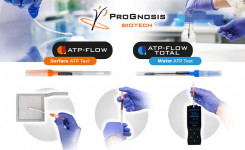
The ATP-Flow series provides bioluminescence-based ATP detection with instrumental reading on the PhosReader 2 luminometer, delivering results in as little as 10 seconds.
ATP-Flow Surface
- Designed for routine verification of surface hygiene
- Portable, on-site, accurate testing with pre-moistened swabs
- Results expressed as Relative Light Units (RLU) on the PhosReader 2, PC or cloud
- Limit of detection: 0.53 fmoles ATP for sensitive pass/fail decisions
Discover how it works in this step-by-step video tutorial:
https://www.youtube.com/watch?v=oXYAQ9hBvHU
ATP-Flow Total Water
- Immediate ATP results for CIP and rinse water monitoring
- Detects both microbial and non-microbial ATP to verify final rinse quality
- Same data handling as ATP-Flow Surface
- Ideal for food, beverage, pharmaceutical and industrial hygiene applications
Protein-Flow: Targeted Control of Protein Residues
Protein-Flow is a surface swab test designed specifically for protein residues that may remain after cleaning, even when ATP values are low.
- Colorimetric, visual results with a clear green-to-purple shift
- Results within 10 minutes, no incubation required
- Semi-quantitative assessment of protein residues on surfaces
- Limit of detection: 10 µg protein
This makes Protein-Flow particularly suitable for verification of food-contact surfaces, filling lines, and areas where organic residues are critical, complementing ATP-based checks rather than replacing them.
ATP-FemtoFlow: Ultra-Sensitive Control for Critical Environments
For high-risk environments such as ICUs, high-dependency units, cleanrooms and biosafety laboratories, ProGnosis Biotech has developed ATP-FemtoFlow, a next-generation ATP surface test with an exceptionally low detection limit.
- Extra-sensitive LOD: 0.13 fmoles ATP, up to four times lower than regular ATP swab tests
- Flexible, pre-moistened swab design for accurate sampling of complex surfaces
- 10-second readings on the PhosReader 2 luminometer
- Data available on the device screen, connected PC or cloud
PhosReader 2 itself is a portable, touchscreen luminometer with automated self-calibration and storage capacity for over 10 million data entries, simplifying trend analysis and audit reporting.
Raising the Bar on What “Clean” Really Means
By combining ultra-sensitive ATP detection with targeted protein residue testing, ProGnosis Biotech moves hygiene verification beyond “clean enough” to truly evidence-based control. Whether you are responsible for a busy ward, a critical cleanroom, or a high-throughput production line, these new Hygiene Monitoring Solutions deliver rapid, objective answers, so you can act faster, document better, and be confident that you can detect even the invisible.
Learn more about ProGnosis Biotech’s Hygiene Monitoring Solutions here
References
- Sassi H.P. et al. (2021) Practical recommendations for routine cleaning and disinfection procedures in healthcare facilities: A narrative review. Journal of Hospital Infection, 113:104–114. ScienceDirect.
- Gensberger-Reigl S. et al. (2023). Visual inspection of surface sanitation: Defining the conditions that are “clean enough”. Food Control, 148:109653. ScienceDirect.
- Bakke M. (2022) A Comprehensive Analysis of ATP Tests: Practical Use and Recent Progress in the Total Adenylate Test for the Effective Monitoring of Hygiene. Journal of Food Protection, 85(7):1079–1095.
- Srčič S. et al. (2019). Evaluation of ATP bioluminescence for monitoring surface hygiene in a hospital pharmacy cleanroom. Journal of Microbiological Methods, 168:105785.