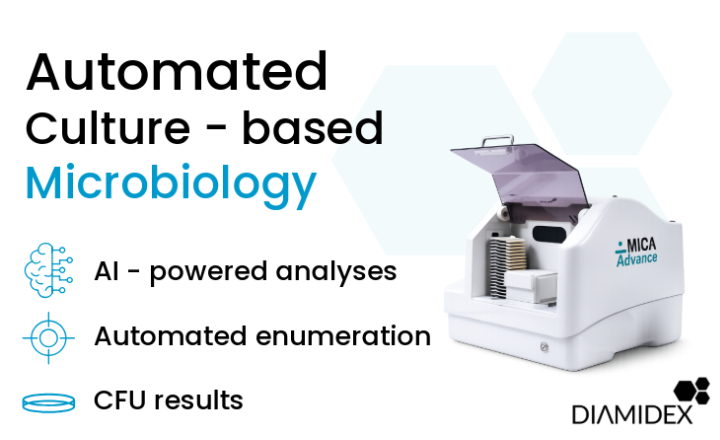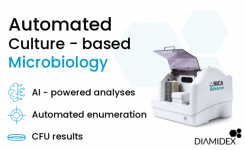

- The MICA Total Coliforms platform reduces variability and labour-intensive manual reading of total coliform tests. Automated, machine‑learning–based reading improves consistency, standardisation, and throughput while keeping existing workflows intact.
- The method retains the familiar membrane filtration, chromogenic agar, and CFU‑based reporting workflow, requiring no new reagents or changes to established SOPs.
- Automated detection identifies coliform microcolonies within 10 hours, producing classical CFU results without additional confirmation testing.
- Studies versus ISO 9308‑1:2014 show high agreement (Sensitivity 0.96, Specificity 1.00), supporting comparability with the reference method.
Why laboratories should look beyond 'manual reading and confirmation.
Routine total coliform testing isn’t just about detecting contamination - it’s about producing consistent, actionable results that fit daily lab workflows. Even with well‑controlled filtration and incubation, manual reading and counting introduce variability (especially when interpreting colored colonies) and consume valuable bench time. Machine learning and automatic reading - when it preserves a familiar culture-based workflow - can therefore deliver value by improving standardization, traceability, and throughput without requiring labs to reinvent their SOPs.
The workflow remains familiar: membrane filtration + chromogenic agar + CFU output
- Membrane filtration for sample processing
- Incubation on chromogenic; coliform agar (CCA) at the same temperature
- CFU-based reporting, compatible with historical trends and decision thresholds
The key difference is the use of machine learning and automated reading: the system detects and enumerates only coliforms at early growth on the membrane (microcolony stage) within 10 hours and outputs a final, classical CFU result. No additional confirmation testing is required, reducing follow‑up work in routine testing, and without additional reagents, enabling an affordable, rapid microbiological method.
Reference comparability: performance vs ISO 9308-1:2014
A comparative study against ISO 9308-1:2014 evaluated real matrices (including bottled waters and mains waters, n = 128 samples) and reported:
Sensitivity: 0.96 and Specificity: 1.00 on real matrices.
Cohen’s Kappa: 0.95, is described as “almost perfect” agreement when applied to ISO 9308-1:2014. These results support positioning the solution as a workflow-compatible, reference-comparable approach for culture-based results.
Analytical sensitivity and reporting confidence
For drinking water labs, detecting low-level events early is important. This method delivers earlier CFU-based results without moving away from culture.
Comparative testing demonstrates reliable performance relative to the reference method, with automated reading to improve consistency in routine workflows. For water testing laboratories this means rather than reframing the lab’s routine methodology, the instrument targets three outcomes that matter in practice:
- Standardized interpretation via machine learning and automated counting
- Culture-based CFU results aligned with existing reporting
- Reference comparability and robustness, supporting SOP integration and confidence in routine deployment. At an affordable price for a rapid method.
Conclusion
The most effective innovations improve reliability and efficiency without disrupting workflows. Our MICA Advance Total Coliforms solution shows strong agreement with ISO 9308-1:2014 and uses machine learning–based automated enumeration to detect total coliforms after just 10 hours of incubation. This solution enables an affordable, rapid microbiological method that supports routine adoption for drinking-water and bottled-water testing.