
In modern seafood supply chains, histamine control is increasingly challenged by a fundamental timing gap. The hazard develops in real time, but verification often arrives too late to influence critical decisions. As seafood moves through high-volume trade routes, compressed logistics windows and increasingly strict regulatory environments, final-stage laboratory confirmation is no longer sufficient. This gap matters because histamine formation is both early and cumulative. It can begin soon after catch and continue through handling, storage and transport whenever time and temperature conditions support bacterial conversion of histidine into histamine. Once formed, histamine remains stable under normal food-handling conditions and cannot be removed by chilling, freezing or cooking. By the time testing is performed, part of the risk may already be present in the product.
The Time-to-Decision Gap
The key limitation is not whether histamine can be measured accurately but whether results are available early enough to guide action. Most histamine testing remains laboratory-based and delayed, meaning that results arrive after operational decisions have already been made. In this model, testing confirms the problem, but it may not prevent it from progressing further through the supply chain. This challenge is amplified in global seafood trade, particularly in high-volume exports from APAC regions into EU and US markets. These supply chains operate under strict regulatory frameworks and customer specifications, while products continue to move through long and complex logistics networks. Compliance pressure is increasing, while testing timelines remain unchanged, creating a widening gap between regulatory expectations and operational reality.
The industry continues to face four major operational constraints:
- Speed: Laboratory methods are accurate, but often too slow for real-time operational use.
- Complexity: Sample preparation remains matrix-dependent and difficult to standardize.
- Portability: Many “rapid” methods still require controlled conditions or specialist handling.
- Verification HACCP systems rely on process indicators rather than real-time biochemical confirmation.
Recent analytical literature reflects this limitation. Kounnoun et al. (2022) note that HPLC methods remain highly validated for histamine quantification in fish and fishery products, but many still require laborious sample extraction and purification. For industry, the critical challenge is no longer analytical capability alone, but time-to-decision.
Moving Toward Operational Histamine Testing
Closing the histamine control gap requires a shift from compliance-based testing toward approaches that support real-time operational decision-making. This is driving increased interest in testing solutions designed around speed, simplicity, minimal sample preparation and true on-site usability.
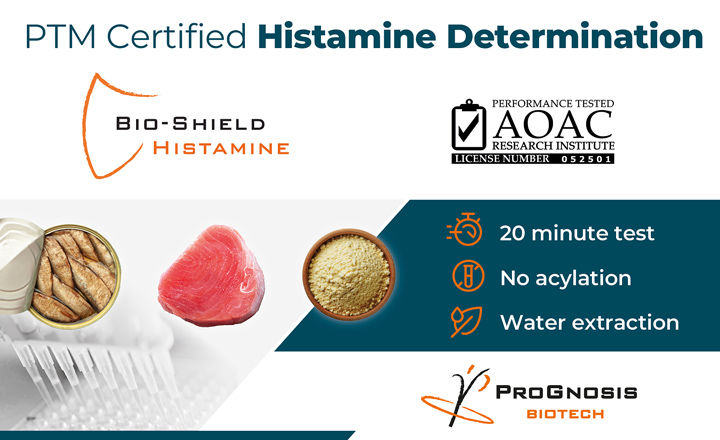
ProGnosis Biotech benchmarks this shift with BioShield Histamine ES. Designed to reduce the barriers that typically limit on-site testing, the system uses water-based extraction and requires no complex reagents, enabling near-immediate sample readiness. This allows histamine verification to move closer to critical operational points, including reception, processing, storage and shipment.
- Results in 20 minutes
- Extremely sensitive detection (LOD at 0.3 ppm)
- No acylation required
- Quantitative digital readout
- 12-month shelf life
The significance is not only faster analysis, but control at the point where it still matters. When quality teams can verify histamine levels at the dock, on the factory floor or before release, testing becomes an active barrier against risk progression rather than delayed confirmation. That is where seafood safety shifts from documenting failures to preventing them.
Learn more about Bio-Shield Histamine ES