




- Meat-borne parasitic zoonoses remain an underrecognized food safety concern, particularly in wild game and minimally processed meat products.
- Current reference methods, particularly digestion-based testing for Trichinella spp. are labor-intensive and primarily target a single parasite.
- Emerging parasites such as Alaria alata and Sarcocystis spp. are increasingly associated with wild game meat, yet standardized surveillance approaches remain limited.
- A rapid, low-resource screening approach capable of simultaneously detecting multiple parasites could improve field surveillance, wildlife monitoring, and food safety testing in resource-limited settings.
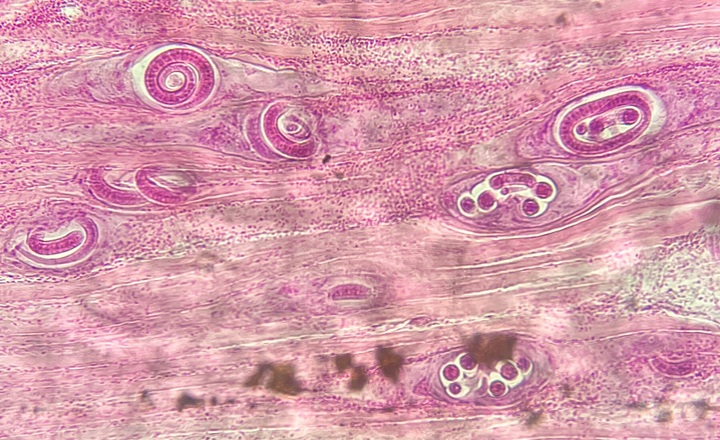
Key Findings: Juhász and Majoros developed a suspension-based screening assay for detection of meat-borne parasites in fresh and processed meat matrices.¹ Encapsulated Trichinella larvae and Alaria alata mesocercariae isolated from naturally infected wild boar were spiked into pork, minced meat, and sausage samples then blended with water, filtered, stained with Nile blue or neutral red, clarified with dilute acetic acid, and examined microscopically. Naturally occurring Sarcocystis cysts were concurrently visualized and enumerated.
- Simultaneous detection of multiple parasites:
- Trichinella larvae
- Alaria alata mesocercariae
- Sarcocystis cysts within muscle tissue
- 100% recovery of spiked Trichinella and Alaria alata was achieved at 5 larvae/cysts per 50 g sample.
- Applicable to processed meat matrices:
- raw meat
- minced meat
- sausage products
- Detection of non-viable parasitic structures: Unlike digestion-based methods, which dissolve non-viable larvae and capsules, the suspension-based workflow preserved both viable and non-viable structures, potentially providing additional epidemiologic and tissue-pathology information.
- Field-compatible workflow: The method requires minimal instrumentation and was designed for rapid deployment in field or low-resource settings where conventional digestion or molecular assays may not be feasible.
- Limitations: The assay was evaluated using experimentally spiked samples and has not yet undergone formal validation or large-scale field performance assessment.
Bigger Picture: The increasing popularity of free-range farming, game meat consumption, and organic production systems may increase human exposure to meat-borne parasites. This study reflects growing recognition that foodborne parasitic hazards remain comparatively underdetected relative to bacterial pathogens within meat safety systems. While regulatory testing programs heavily emphasize bacterial contamination, surveillance for parasitic zoonoses in game meat and processed meat products remains limited despite documented risks associated with Trichinella, Alaria alata, and Sarcocystis spp.
The study also highlights the need for practical, low-resource screening approaches capable of supporting decentralized surveillance and field-based testing. Unlike conventional digestion methods that primarily target viable Trichinella larvae, this workflow enables simultaneous visualization of multiple parasite types, including non-viable and calcified structures that may provide additional epidemiologic insight.
Although additional validation is required before regulatory adoption, the method may have applications in:
- wildlife surveillance
- hunting and game inspection programs
- resource-limited veterinary diagnostics
- research on co-infections and parasite ecology
- preliminary screening of processed meat products
- evaluation of other animal-derived tissues, including fish
(Image Credit: iStock/ Filippo Arteconi)